 Français
 Deutsch
 English
 Español
 Italiano
Multicoloured Tourmaline


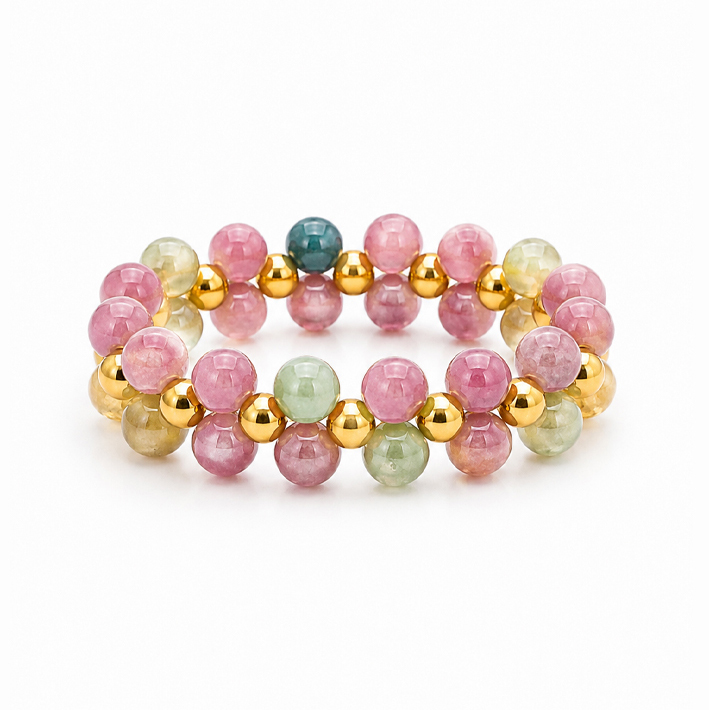
Discover our Multicolour Tourmaline products
Stories and legends
The name tourmaline comes from “turmali” or “turamali”, which was actually a Sinhalese name given to this fabulous stone from Sri Lanka by Dutch explorers in the early 18th century.
In Sri Lanka, a legend says that tourmaline comes from the sky and, as it descended to Earth, it passed through a rainbow that gave it its colour variations. This explains the origin of its name, meaning “the stone of a thousand colours”.
In fact, tourmaline has been known for thousands of years. Traces of this stone can be found as far back as the 3rd century BC. In Greece, it was Alexander the Great (356-323 BC) who brought this stone back from his expeditions. However, tourmaline, because of its many colours, was very often confused with other minerals.
As a result, very few legends or myths are attached to this stone due to its late identification. However, some tourmalines have piezoelectric properties, which means they carry an electrical charge, negative at one pole and positive at the other. Tourmaline attracts particles to itself.
When the philosopher Theophrastus (-322 to -288) describes a stone with the ability to attract pieces of straw or wood, we understand that he is talking about tourmaline. Later in the 18th century, Dutch explorers used tourmaline to clean their pipes, because the stone attracted ash.
As an anecdote, in the 16th century, a Spanish conquistador discovered a green tourmaline in Brazil, which he identified as an emerald. This discovery triggered a rush into the Brazilian regions in search of these famous emeralds. The mistake was corrected in the 19th century and the emeralds turned into tourmalines.
Mistaken many times for precious stones, tourmalines are therefore found in many pieces of jewellery, and even in the British Crown Jewels. We can also mention the Timur Ruby, a 352-carat jewel that was thought to be a ruby until 1851, or the Black Prince’s Ruby of 170 carats, which is actually a tourmaline.
Tourmaline is generating more and more enthusiasm among connoisseurs and collectors. For example, the Chinese Empress Cixi (1861-1908) loved this stone so much that she began collecting it. She had sculptures, brooches, watch fobs, rings, etc. made for her. Today she rests on a cushion of tourmalines.
The main deposits are located in Brazil, Afghanistan, Australia, Brazil, Russia, Thailand, Burma, Madagascar, India and the United States.
Multicolour tourmalines
A quick reminder
Tourmalines come in various shades. They can also be bicoloured or multicoloured. There is a wide variety of tourmalines, in different colours, ranging from opaque to transparent, with striated or hexagonal structures. They have a rhombohedral crystal system. It is an igneous and metamorphic rock that can come from hydrothermal deposits.
Tourmalines therefore have varied compositions such as magnesium silicates, sodium silicates, iron, clay, fluorides and borosilicate. Tourmalines are in fact an entire family of stones that share the same internal structure but differ in chemical composition and therefore in colour and appearance.
The tourmaline family is an appealing variety in the world of fine stones. They crystallise in every possible colour. They are highly prized in jewellery because they are hard (7 to 7.5). They have radiant colours and exceptional brilliance.
The strong birefringence of tourmalines means that two tourmalines are practically never the same colour. Jewellery designers can therefore offer unique, highly original creations. Gem-quality (transparent) tourmaline will be faceted into various shapes (pear, oval, round, etc.). Translucent to opaque tourmaline with well-defined colours will be cut as cabochons or polished slices.
Tourmalines come in a range of colours and can therefore be combined when creating bracelets or necklaces. Let’s take another look at the most commonly used ones.
Blue tourmaline
Blue tourmaline is also known as indigolite or indicolite. It is a stone with a light blue to dark blue colour. It stands out from other tourmalines by appearing transparent in its rough form.
In lithotherapy, it is a stone of soothing and serenity. It frees the mind from negative thoughts. It encourages loyalty in love as well as friendship and honesty. Blue tourmaline dispels feelings of sadness, discomfort and despair to make way for positive feelings.
Its astrological signs : Sagittarius, Aquarius, Pisces
Its chakra : the throat chakra
Brown tourmaline
Brown tourmaline, or dravite, is a variety of tourmaline that is brown or mahogany in colour, sometimes so dark that it is mistaken for black tourmaline. It is a mineral from the cyclosilicate family, a sodium, aluminium and magnesium hydroxyl silicate.
In lithotherapy, it helps overcome life’s difficulties and gives the courage to accept the unthinkable. It helps make peace with the past and identify the source of certain blocks often linked to childhood. Brown tourmaline is a magnesium-rich stone. It helps its wearer better absorb magnesium during supplementation courses.
Its astrological signs : Aries, Virgo, Scorpio
Its chakra : the root chakra
Yellow tourmaline
There are different varieties of yellow tourmaline (Malawi tourmaline, elbaite, tsilaisite, etc.).
It should be noted that yellow tourmaline is among the most expensive varieties of tourmaline. The price of these yellow tourmalines varies according to their quality, purity, origin and weight. A tourmaline set in a ring can fetch around one hundred euros.
In lithotherapy, yellow tourmaline is appreciated for its energising virtues. It is a stone of dynamism and vitality. It helps people who are mentally and physically tired recover their energy and the will to achieve their goals. A stress-relief stone, it also helps overcome states of intense sadness.
Its astrological signs : Taurus, Leo, Libra
Its chakra : the solar plexus chakra
Black tourmaline
Black tourmaline is the best-known variety of tourmaline. It is also known as schorl. It is said to be black, but it can also be dark brown. It gained its reputation over time because of its many properties.
It is the most common tourmaline and can sometimes measure up to 2 m high. Its composition, very rich in iron, gives it this black, opaque and intense appearance.
In lithotherapy, black tourmaline is a very powerful grounding stone. It helps keep you grounded, calms scattered thoughts and recentres attention. A fantastic anti-stress stone, black tourmaline diffuses energy and vitality.
Its astrological signs : Cancer, Sagittarius, Capricorn
Its chakra : the root chakra
Cat’s eye tourmaline
Cat’s eye tourmaline is one of the rarest varieties of tourmaline. It gets its name from the light-reflection phenomenon that recalls the slit eye of a cat. This phenomenon is called chatoyancy.
This optical feature is exceptionally rare and is found in only a handful of fine stones. It is caused by the presence of tiny parallel fibres or needle-like inclusions in the stone.
In lithotherapy, cat’s eye tourmaline, like many other tourmalines, repels negative energies. It is an excellent protection stone that helps keep away people with bad influences. It is also known to strengthen the immune system and promote the healthy circulation of bodily fluids.
Its astrological signs : Leo, Libra, Aquarius
Its chakra : the sacral chakra
Pink tourmaline
Pink tourmaline (or rubellite when it tends toward red) is composed of complex borosilicate silicates, with iron, alkalis and magnesium. It also contains a high level of copper and manganese, which gives it this beautiful pink colour. Pink tourmaline can be transparent, translucent or even opaque.
Pink tourmaline is a stone often associated with other minerals. The most common combinations are pink tourmaline with eudialyte, pink tourmaline with lepidolite and pink tourmaline with rose quartz.
In lithotherapy, pink tourmaline is closely linked to feelings of love and tenderness. It emits vibrations that help rebuild and protect mental well-being. Pink tourmaline brings serenity and helps its wearer effectively combat stress and its effects on the body.
Its astrological signs : Aries, Libra, Scorpio
Its chakra : the heart chakra
Green tourmaline
Green tourmaline is also known as verdelite. It comes in different shades of green, with that transparent appearance. Green tourmaline is the most widespread after black tourmaline. More rarely, other green tourmalines such as chrome-bearing varieties can be found. These are rarer and more sought-after.
In lithotherapy, the beautiful green colours of this tourmaline evoke the greens found in nature in spring, the season of renewal. Green tourmaline is therefore said to be excellent for anyone who wants to start over from scratch. It gives them the strength to leave a toxic relationship, a thankless job, etc. Placing a green tourmaline in a bedroom helps keep restless thoughts away at bedtime. A sense of softness sets in and encourages falling asleep.
Its astrological signs : Libra, Capricorn, Pisces
Its chakra : the brow chakra
Maintenance, cleansing and recharging of tourmalines
Each tourmaline has its own way of being cared for, cleansed and recharged. Refer to the texts corresponding to the colour of your tourmaline. If you have a piece of jewellery with several tourmalines, proceed as follows:
For maintenance: carry out the following steps at least once a month:
Soak your stone in a glass of spring water for 2 hours. Dry it gently with a soft cloth. For a lighter cleansing, opt for white sage fumigation or a Tibetan singing bowl.
Recharge your stone in the afternoon sunlight for 2 hours or place it in an amethyst geode or on a quartz cluster for 24 hours.