 Français
 Deutsch
 English
 Español
 Italiano
Pyrite on Serpentine
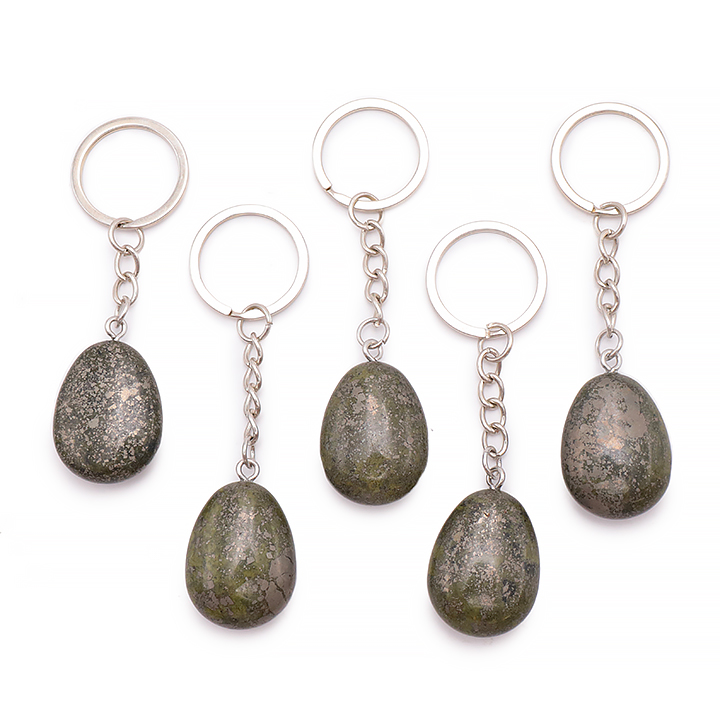
Discover all our Pyrite on Serpentine stones
History, legends and characteristics
Pyrite on serpentine is the result of a complex geological process that combines the interaction between sulphide minerals and ultramafic rocks (rich in magnesium and iron).
Serpentine belongs to the family of magnesium silicate minerals formed by the hydrothermal alteration of these ultramafic rocks, mainly peridotites and dunites, rich in olivine and pyroxenes. Under the action of water loaded with carbon dioxide and various chemical elements, olivine is transformed into serpentine through a process called serpentinization. This phenomenon creates a rock with a characteristic green colour and varied shades.
Pyrite, an iron sulphide, generally forms in environments where iron is abundant and sulphur-rich hydrothermal fluids circulate. Under certain conditions, serpentine minerals contain enough iron to react with these fluids and give rise to pyrite deposits. This process can occur in various geological settings, including hydrothermal metamorphic zones or near underwater hot springs.
The association between pyrite and serpentine therefore results from a dual transformation:
- On the one hand, peridotite alters into serpentine under the effect of water and carbon dioxide.
- On the other, the iron released by these transformations reacts with dissolved sulphur to crystallise into pyrite.
This process leads to the formation of pyrite inclusions in serpentine, in the form of golden veins or small sparkling clusters scattered through the green rock.
Pyrite on serpentine has a distinctive appearance: a green background tinged with yellow or brown, enhanced by flecks or golden crystalline structures. Serpentine has a hardness of between 2.5 and 5.5 on the Mohs scale, while pyrite is harder (6 to 6.5 on the same scale).
Serpentine, often used as an ornamental stone, is also used in industrial applications, especially as thermal insulation and a refractory material. Pyrite, for its part, was long used for sulphur extraction, used in the manufacture of sulphuric acid, and also served in the production of iron and gold through metallurgical processes.
The history of pyrite on serpentine is ancient, but it was not until the 19th century that it was truly studied. The first scientific descriptions date back to James Dwight Dana (1813-1895), the American geologist who classified many minerals.
Throughout the ages, serpentine has been revered for its green colour, reminiscent of the forces of nature and regeneration. Among the Romans, it was used as a talisman against poisons and snake bites, a belief inherited from the Egyptians who carved amulets from this stone.
Pyrite, for its part, has long been associated with protection and prosperity, particularly among Inca and Aztec civilisations, which considered it a solar stone.
The main deposits of pyrite on serpentine are located in Italy, the Alps, the United States, Russia, Peru and China.

The benefits of pyrite on serpentine in lithotherapy
Its benefits on a psychological level
Pyrite on serpentine is a stone combining the strength of pyrite with the soothing energy of serpentine. It is perfect for people going through periods of doubt or emotional instability. By promoting mental clarity, it helps structure thoughts and channel energy towards concrete goals. It is useful for those who feel overwhelmed by their responsibilities or who tend to procrastinate, helping them better organise their actions and strengthen their willpower.
This stone also helps overcome certain fears, particularly those linked to the unknown or to change. Serpentine, with its soothing energy, makes it easier to adapt to new situations by bringing a sense of inner security. Pyrite, on the other hand, brings a positive dynamic, encouraging decision-making and self-assertion.
For those who constantly doubt themselves or are easily discouraged, pyrite on serpentine encourages a more confident and determined attitude. It supports the ability to overcome blocks and face challenges with greater confidence. This stone is ideal for those who want to move forward without being held back by their uncertainties.
Its benefits on a physical level
Pyrite on serpentine is an ideal grounding stone for people looking to adopt a more balanced lifestyle.
Thanks to the dynamic energy of pyrite, it encourages motivation and perseverance, important qualities for regaining a healthy lifestyle rhythm, especially when returning to physical activity or changing diet.
By promoting peace of mind, serpentine helps release accumulated tension and ease stress. Placed in a bedroom, it supports falling asleep and promotes more restorative sleep.
By combining vitality and serenity, pyrite on serpentine accompanies those who wish to move forward with greater stability, confidence and overall balance.
Pyrite on serpentine and astrological signs
Pyrite on serpentine is a stone with many benefits acting on all astrological signs, especially by promoting harmony and stability. However, its benefits are felt even more intensely in the following signs:
- Taurus : Taurus, an Earth sign, is grounded in stability, abundance and the simple pleasures of life. Very patient and generous, it values security and material comfort, while being faithful and loyal to those close to it. However, stubbornness and a refusal of change can sometimes make it rigid and not very adaptable. Pyrite on serpentine helps balance its stability while encouraging it to open its mind to change without disturbing its equilibrium. In love, it is a loyal, sensual partner seeking a stable relationship, but jealousy and a need for control can create obstacles to harmony in the couple.
 Virgo : Virgo stands out for its analytical intelligence, attention to detail and need for perfection. A hard worker, it is able to stay calm in times of crisis and find practical solutions. However, its quest for perfection can lead to excessive criticism, anxiety and stress. Pyrite on serpentine helps it take a step back, reduce pressure and focus on what matters most. In love, it is reserved, cautious and takes time to commit. Once trust is established, it becomes a reliable and devoted partner.
- Capricorn : Capricorn is a determined, ambitious and methodical sign, always ready to work hard to achieve its goals. Its discipline and sense of responsibility make it a reliable pillar, but its perfectionism and rigour can make it distant and isolated. Pyrite on serpentine helps lighten its mental burden, channel its energy better and face challenges with less pressure. In love, it is cautious and takes its time before committing, but once trust is established, it becomes a stable, protective and loyal partner, even if it sometimes struggles to express its emotions.
Pyrite on serpentine and chakras

Pyrite on serpentine helps balance the heart chakra, the energy centre of love and harmony. It helps to release stagnant energy in this chakra. It promotes better emotional management and helps dispel emotional blockages.
When this chakra is balanced, the person is attentive to others, maintaining peaceful and caring relationships. It also facilitates self-acceptance and letting go, creating a sense of inner peace.
Conversely, a blocked heart chakra can lead to emotional tension, difficulty opening up to others and a sense of isolation.
A closed heart chakra can lead to rejection of emotions, emotional coldness and an inability to form genuine bonds.
Caring for, cleansing and recharging pyrite on serpentine
Since being extracted, pyrite on serpentine has passed through many environments and absorbed various energies. Handled, transported and exposed to different influences, it can become charged with disruptive waves that alter its natural balance.
As soon as it arrives at your home, and in order to restore all its effectiveness, it is essential to cleanse and recharge it. The following actions should be carried out for maintenance at least once a month.
Cleansing can be done by fumigation with white sage or Palo Santo, whose smoke drives away stagnant energies. It is also possible to place it for a few hours in a glass on a bed of salt, without direct contact, to avoid any alteration of the pyrite on serpentine.
To recharge it, exposure to morning sunlight for 2 or 3 hours is enough. It can also be placed on a quartz geode or an amethyst cluster for 24 hours.
Warning, this stone should not be immersed in either water or salt.