 Français
 Deutsch
 English
 Español
 Italiano
Pink tourmaline on eudialyte | on lepidolite | on quartz
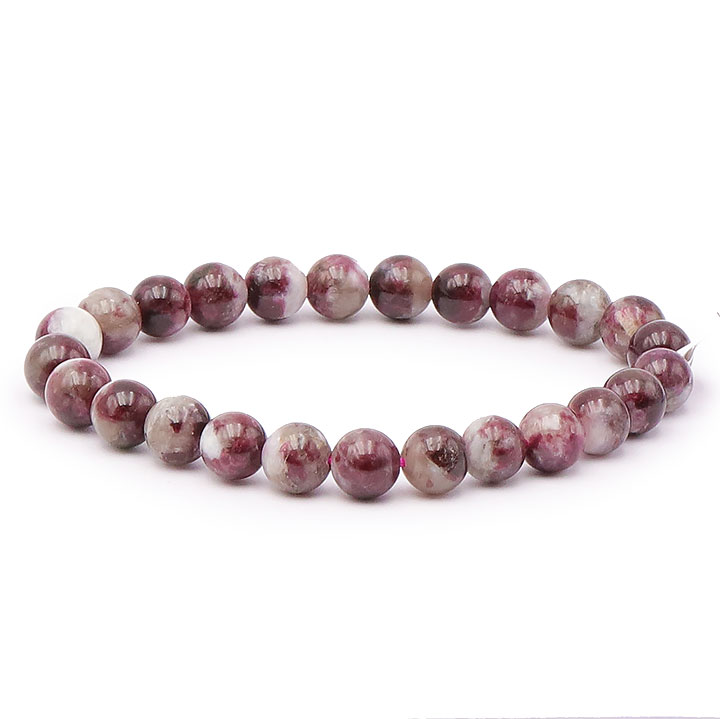
Find all our products in Pink Tourmaline on Eudialyte / on Lepidolite / on Rose Quartz
Stories and legends
The name tourmaline comes from “turmali” or “turamali”, which is actually a Sinhalese name given to this fabulous stone from Sri Lanka by Dutch explorers in the early 18th century.
In Sri Lanka, a legend says that tourmaline comes from the sky and, as it descended to earth, it passed through a rainbow that gave it its color variations. This explains the origin of its name, meaning “the stone of a thousand colors”.
In fact, tourmaline has been known for thousands of years. Traces of this stone date back to the 3rd century BC. In Greece, it was Alexander the Great (356-323 BC) who brought this stone back from his expeditions. However, tourmaline, because of its many colors, was very often confused with other minerals.
Thus, there are very few legends or myths attached to this stone because it was identified late. However, some tourmalines have piezoelectric properties, which means they carry an electric charge, negative at one pole and positive at the other. Tourmaline attracts particles to itself.
When the philosopher Theophrastus (-322 to -288) describes a stone with the ability to attract pieces of straw or bits of wood, we understand that he is speaking about tourmaline. Later in the 18th century, Dutch explorers used tourmaline to clean their pipes because the stone attracted ashes.
As an anecdote, in the 16th century, a Spanish conquistador discovered a green tourmaline in Brazil, which he identified as an emerald. This discovery triggered a rush into the Brazilian regions in search of these famous emeralds. The mistake was corrected in the 19th century and the emeralds turned out to be tourmalines.
Frequently mistaken for precious stones, tourmalines are therefore found in many pieces of jewelry, and even in the British Crown Jewels. One can also mention the Timur Ruby, a 352-carat jewel thought to be a ruby until 1851, or the Black Prince's Ruby of 170 carats, which is in fact a tourmaline.
Tourmaline is generating more and more enthusiasm among connoisseurs and collectors. Thus, the Chinese Empress Cixi (1861-1908) loved this stone so much that she began collecting it. She asked for sculptures, brooches, watch fobs, rings, etc. to be made for her. She now rests on a cushion of tourmalines.
Tourmaline comes in a variety of shades. They can also be bicolored or multicolored. There is a wide variety of tourmalines, in different colors, from opaque to transparent, with striated or hexagonal structures. It has a rhombohedral crystal system. It is an igneous and metamorphic rock that can come from hydrothermal deposits.
Thus, there are several kinds of tourmaline with varied compositions such as magnesium, sodium and iron silicates, clay, fluorides and borosilicate. Tourmalines are in fact a whole family of stones that share the same internal structure but differ in chemical composition and therefore in color and appearance.
The main deposits are located in Brazil, Afghanistan, Australia, Brazil, Russia, Thailand, Burma, Madagascar, India, and the United States.
Pink tourmaline on eudialyte | On lepidolite | On rose quartz
Tourmaline is a stone often associated with other minerals. The most common combinations are pink tourmaline on eudialyte, pink tourmaline on lepidolite, and pink tourmaline on rose quartz.
You can find all the characteristics of pink tourmaline in the article dedicated to it. Here, we will focus more specifically on the benefits of these minerals that accompany these pink tourmalines.
Pink tourmaline on eudialyte
The pairing of pink tourmaline and eudialyte strengthens the effectiveness of both stones. We have already seen the properties of pink tourmaline. We will now look at those of eudialyte.
Eudialyte is a pink variety of garnet, distinguished by the fact that it is often associated with various other minerals, namely pink tourmaline. Its pink is darker and can sometimes turn brown, but this remains quite rare.
The name eudialyte comes from the Greek meaning well and soluble. It belongs to the silicate group, sub-group of cyclosilicates. It is soluble in acids, hence its name. It was identified by Friedrich Strohmeyer in 1818 following the discovery of a specimen from the southwest coast of Greenland.
Eudialyte is composed of sodium, calcium, cerium, iron, manganese and zirconium cyclosilicates. It has a hardness of 5.5 on the Mohs scale. By comparison, diamond has the highest hardness on the same scale, 10.
It is a relatively affordable stone, even when set in jewelry. However, some high-quality pendants can reach around one hundred euros.
Its main deposits are located in Russia, Canada, the United States and Greenland.
The benefits of pink tourmaline on eudialyte
Its benefits on the mental and emotional level
The benefits of pink tourmaline (see the text on pink tourmaline) are combined with those of eudialyte. Eudialyte helps release negative emotions such as anguish and anxiety. Combined with pink tourmaline, it encourages introspection and reconnection with the inner self. It brings about an understanding of traumas often linked to childhood.
Thus, it is ideal for making a fresh start. It helps overcome grief, suffering and guilt. Pink tourmaline on eudialyte is a stone of resilience. It helps rebuild both emotionally and professionally. It gives the courage to take action. It is a stone of liberation that helps overcome sorrow and doubt. It restores self-confidence.
Its benefits on the physical level
Tourmaline on eudialyte is a stone of resilience: it is ideal for healing bones after an injury or surgery. It encourages its wearer to carry out physiotherapy exercises correctly, which promotes healing.
It is also an anti-stress stone that clears away restless thoughts at bedtime. It thus promotes better sleep quality by keeping nightmares away.
Pink tourmaline on eudialyte and the associated zodiac signs
Pink tourmaline on eudialyte, just like pink tourmaline, has a special affinity with the Aries zodiac sign: find the characteristics of this sign in the text on pink tourmaline.
Pink tourmaline on eudialyte and the chakras
Pink tourmaline on eudialyte, just like pink tourmaline, helps balance the heart chakra. Find out the importance of having a harmonized heart chakra in the text on pink tourmaline.
Pink tourmaline on lepidolite
The pairing of pink tourmaline and lepidolite strengthens the effectiveness of both stones. We have already seen the properties of pink tourmaline. We will now look at those of lepidolite.
You can find more information about lepidolite by reading the article dedicated to it. Here is a summary of that text:
Lepidolite takes its name from the Greek “lepis”, meaning scale, in reference to the stone's structure. Its name was given to it by the German chemist Martin Heinrich Klaproth (1743-1817). This stone is composed of lithium, silicon, aluminum and manganese. Manganese gives it its beautiful lilac color.
Lepidolite can be mistaken for muscovite, but the latter does not have its beautiful colors. However, lepidolite is a mineral that can be colorless or white, more rarely yellow or green, or even pale red. Nevertheless, the most common colors are pink, violet or purple.
This stone belongs to the large mica family. It occurs as tabular, prismatic or pseudo-hexagonal crystals. It has a hardness of 3 on the Mohs scale. By comparison, diamond has the highest hardness, 10 on the same scale. Lepidolite is therefore considered a fragile stone.
Its main deposits are located in Brazil, Tanzania, Madagascar, India, the United States and Zimbabwe.
The benefits of pink tourmaline on lepidolite in lithotherapy
Its benefits on the mental and emotional level
Pink tourmaline combined with lepidolite gives its wearer a sense of well-being, strong self-confidence and assurance. They feel a great deal of serenity and can fight negative thoughts.
This combination strengthens concentration, imagination and memory. It enables its wearer to achieve the goals they have set for themselves. It is said to stabilize mood and suits indecisive people who often change their minds.
Like many mauve and violet stones, pink tourmaline on lepidolite develops spirituality and encourages meditation. It allows reconnection with one's inner self and makes it possible to identify blockages often linked to childhood traumas.
Its benefits on the physical level
Pink tourmaline on lepidolite brings serenity and effectively fights stress, nervousness and indecision.
Thanks to its soothing virtues, pink tourmaline on lepidolite promotes quality, restorative sleep. The wearer wakes up full of vitality and energy. They feel strong enough to take up physical activity again. In addition, this combination is known for strengthening the body as a whole.
Pink tourmaline on lepidolite and the associated zodiac signs
Pink tourmaline on lepidolite, just like pink tourmaline, has a special affinity with the Libra zodiac sign: find the characteristics of this sign in the text on pink tourmaline.
Pink tourmaline on lepidolite and the chakras
Pink tourmaline on lepidolite, just like pink tourmaline, helps balance the heart chakra. Find out the importance of having a harmonized heart chakra in the text on pink tourmaline.
Pink tourmaline on rose quartz
The pairing of pink tourmaline and rose quartz strengthens the effectiveness of both stones. We have already seen the properties of pink tourmaline. We will now look at those of rose quartz.
You can find more information about rose quartz by reading the article dedicated to it. Here is a summary of that text:
Quartz, the most abundant mineral in the Earth's crust, belongs to the large silicate family, sub-group of tectosilicates. It has a beautiful pink color due to various metallic oxide inclusions, such as manganese, titanium and dumortierite. Pure, transparent quartz is called rock crystal.
The word quartz comes from “quartez”, meaning “bad ore”. It was only in the 16th century that a German scholar stated that the term quartz referred only to rock crystal.
The first traces of rose quartz appeared about 7,000 years ago in Mesopotamia (modern-day Iraq).
Rose quartz has a hardness of 7 on the Mohs scale. By comparison, diamond has a hardness of 10, the highest on the same scale. It has a translucent appearance, more or less cloudy.
Its main deposits are located in Brazil, etc.

The benefits of pink tourmaline on rose quartz in lithotherapy
Its benefits on the mental and emotional level
Pink tourmaline on rose quartz is a powerful stone for healing deep emotional wounds, painful losses and overcoming childhood traumas, often caused by a lack of love.
This combination represents love: self-love and love of others. It brings calm, serenity and confidence. It fights negative emotions such as anxiety, anguish and buried fears. It opens the wearer to happiness, joy and acceptance of love.
Pink tourmaline on rose quartz encourages openness toward others, without distrust and without doubt. It fills emotional deficiencies. It gives rise to compassion, empathy and understanding.
Its benefits on the physical level
Pink tourmaline on rose quartz is a powerful combination against stress and its harmful effects on the body.
This combination of pink stones is known for maintaining libido, even in long-established couples. It strengthens love in all relationships.
Pink tourmaline on rose quartz and the associated zodiac signs
Pink tourmaline on rose quartz, just like pink tourmaline, has a special affinity with the Scorpio zodiac sign: find the characteristics of this sign in the text on pink tourmaline.
Pink tourmaline on rose quartz and the chakras
Pink tourmaline on rose quartz, just like pink tourmaline, helps balance the heart chakra. Find out the importance of having a harmonized heart chakra in the text on pink tourmaline.
Caring for, cleansing and recharging pink tourmaline
Whether it is pink tourmaline on eudialyte, pink tourmaline on lepidolite or pink tourmaline on rose quartz, the care for these stones is the same as for pink tourmaline. Here are the steps to follow as soon as your stone arrives in your home.
First, it is essential to cleanse it, then recharge it. The following steps should be repeated for maintenance at least once a month or after use in lithotherapy.
Immerse your pink tourmaline on eudialyte, on lepidolite or on rose quartz in a glass of spring water for 2 hours. Dry it with a soft cloth. For a gentler cleansing, opt for fumigation with white sage, a flower of life and a Tibetan singing bowl.
Recharge your stone in the afternoon sunlight for 2 hours. You can also place it in an amethyst geode.